• Skip to primary navigation
  • Skip to main content
  • Skip to footer

Top 10 Wine Coolers

wine cooler fridge reviews, wine pairing and lifestyle blogs

  • Top 10 Wine Coolers
  • Home
  • Capacity
    • 10-29 Bottle
    • 30-59 Bottle
    • 60-99 Bottle
    • 100-199 Bottle
    • 200-299 Bottle
    • 300-399 Bottle
  • Zone
    • Single-Zone
    • Dual-Zone
    • Multi-zone
  • By Brand
    • Allavino
      • Allavino 305-Bottle Single-Zone
      • Allavino 172-bottle Dual-Zone
      • Allavino 128 bottle Single-Zone
      • Allavino 112 bottle Four-Zone
      • Allavino 99-bottle Dual-Zone
      • Allavino 56-bottle Dual-Zone
      • Allavino 56-bottle Single Zone
      • Allavino 36-bottle Dual-Zone
      • Allavino Cascina 34-bottle wine cooler review
      • Allavino 30-bottle Single-Zone
      • Allavino Cascina 29-bottle wine cooler review
      • Allavino 16-bottle Single-Zone
    • EdgeStar
      • EdgeStar 332 Bottle Dual-Zone
      • Edgestar 242 Bottle Dual-Zone
      • EdgeStar 143 Bottle Triple-Zone
      • EdgeStar 110 Bottle Dual-Zone
      • EdgeStar 46-Bottle Dual-Zone
      • EdgeStar 30-Inch Wine and Beverage
      • EdgeStar 15-inch 26-Bottle Dual-Zone
    • Haier
      • Haier 12-Bottle Dual Zone
      • Haier 18-Bottle Dual Zone
    • Kalamera
      • Kalamera 18-bottle Single-Zone
      • Kalamera 30-bottle Single-Zone
      • Kalamera 40-bottle French-doors Dual-Zone
      • Kalamera 46-bottle Dual-Zone
      • Kalamera 50-bottle Single-Zone
      • Kalamera 157-bottle Dual-Zone
    • NewAir
      • NewAir 160-bottle Dual-Zone
      • NewAir 116-bottle Dual-Zone
      • NewAir 52-bottle Single-Zone
      • NewAir 46 bottle Dual-Zone
      • NewAir 29-bottle Dual-Zone
      • NewAir 28-bottle Single-Zone thermoelectric
      • NewAir 21-bottle Dual-Zone thermoelectric
      • NewAir 18-bottle Single-Zone Thermoelectric
      • NewAir 12-bottle Single-Zone thermoelectric
    • Vinotemp
      • Vinotemp 165-Bottle Single-Zone
      • Vinotemp 155-Bottle Dual-Zone Connoisseur Series
      • Vinotemp 155 Bottle Dual-Zone
      • Vinotemp 154-Bottle Dual-Zone
      • Vinotemp 110 Bottle Dual-Zone
  • Blogs
    • Lifestyle of Entertaining
    • Wine Tips
    • Wine gifts
    • Food and Wine Pairing

Jackie Paley

By Jackie Paley Leave a Comment

Wine Fridge vs. Regular Refrigerator: Why Wine Needs a Dedicated Home

If you are currently keeping your curated wine collection nestled between the milk carton and last night’s leftovers, your investment is in quiet, constant danger. It is a common misconception that a standard kitchen refrigerator is a safe haven for wine. In reality, a regular household fridge is engineered for a completely different purpose: to keep perishable food bone-dry and aggressively cold. To fine wine, that environment is a hostile cocktail of three silent killers: microscopic compressor vibrations that stir up sediment, bone-dry air that shrinks corks, and harsh, unshielded lighting.

Protecting your wine collection requires an environment built for preservation, not just refrigeration. Here is the exact science behind why standard fridges fail, and how premium wine coolers employ advanced technology to keep your bottles pristine.

In this guide, you’ll learn:

  • The key difference between a wine fridge and refrigerator
  • Why standard fridges can be damaging for wine stored long term
  • How temperature, humidity, vibration, and light affect bottles
  • Which wine-fridge features are worth prioritizing for your collection
  • Why a dedicated cooler can make entertaining easier
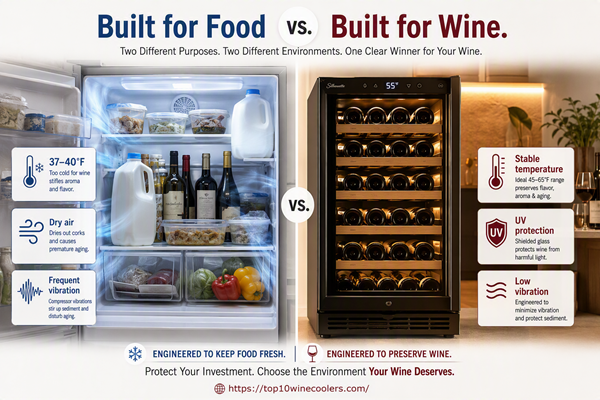
Wine fridge vs standard refrigerator comparison for long-term wine storage

The Kitchen Fridge vs. the Wine Cooler: A Core Overview

The most important difference between a wine fridge and refrigerator is simple: a kitchen refrigerator is designed to slow food spoilage, while a wine fridge is designed to preserve wine’s flavor, structure, and aging potential.

A standard refrigerator typically operates around 37°F to 40°F. That is excellent for milk, produce, leftovers, and meat—but it is generally too cold for long-term wine storage. It also cycles frequently to maintain food-safe temperatures, moving dry, refrigerated air throughout the compartment. That environment helps prevent food from spoiling, but it is not ideal for natural corks or wines intended to mature gracefully.

A dedicated wine cooler, by comparison, is built around the needs of bottled wine. Most models allow you to set a stable temperature about 45°F to 65°F, depending on the wine and whether you are storing or serving it. They also tend to include features such as vibration-reducing compressors, UV-protected glass, pull-out shelving, and softer interior lighting.

That does not mean you can never put wine in a regular refrigerator. A standard fridge is perfectly useful for chilling a bottle of Sauvignon Blanc, rosé, Champagne, or Pinot Grigio before dinner. The issue is long-term storage. If you are asking, can you store wine in a regular fridge long term? The practical answer is: No—not if you want to give cork-finished bottles and age-worthy wines their best chance.

For a few days or even a couple of weeks, your kitchen fridge is a convenient short-term chilling tool. For months or years, a wine fridge is the more appropriate protective environment.

The Three Enemies of Wine Aging (And How Regular Fridges Fail)

Wine is remarkably resilient in some ways, but it is also sensitive to its surroundings. A bottle meant for cellaring is not just a beverage waiting to be opened; it is a living product that continues to evolve. The goal of storage is not to make wine colder; it is to keep its environment stable.
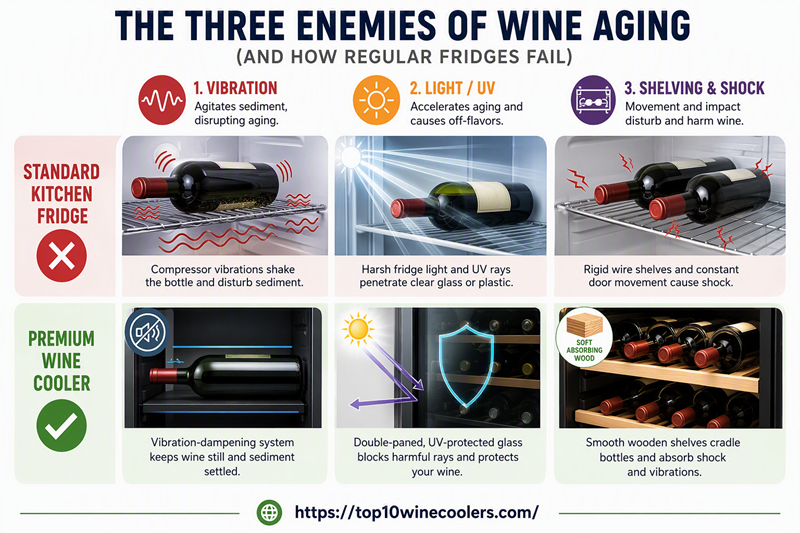
comparison chart showing standard refrigerator vs premium wine cooler features

Temperature: Why 40°F Is Too Cold for Varietals

The ideal long-term storage temperature for most wines is often cited around 55°F, with consistency being just as important as the number itself. A wine fridge lets you maintain a stable, moderate setting that protects the wine whether you are storing Cabernet Sauvignon, Chardonnay, Pinot Noir, or sparkling wine.

By contrast, the 37°F to 40°F temperature in a household refrigerator is intended for food safety. Keeping wine at that temperature for an extended period can slow its development and, more importantly, expose it to repeated temperature fluctuations every time the door opens, warm leftovers are added, or the refrigerator enters a cooling cycle.

Cold storage can also dry out natural corks over time. As cork loses moisture and elasticity, it may no longer maintain as reliable a seal. That can allow more oxygen into the bottle than intended, potentially accelerating oxidation and dulling the wine’s fruit, aroma, and complexity.

Wine does not need to be frozen or near-frozen to be protected. It needs consistency. A dedicated wine fridge keeps bottles at a storage-friendly temperature without the aggressive cold of the kitchen refrigerator.

Humidity: How Dry Air Shrinks and Destroys Corks

Your kitchen refrigerator is designed to remove moisture from the air. That dry environment helps keep food fresher and discourages mold and bacterial growth. For wine with natural cork closures, however, excessively dry conditions can become a concern over long storage periods.
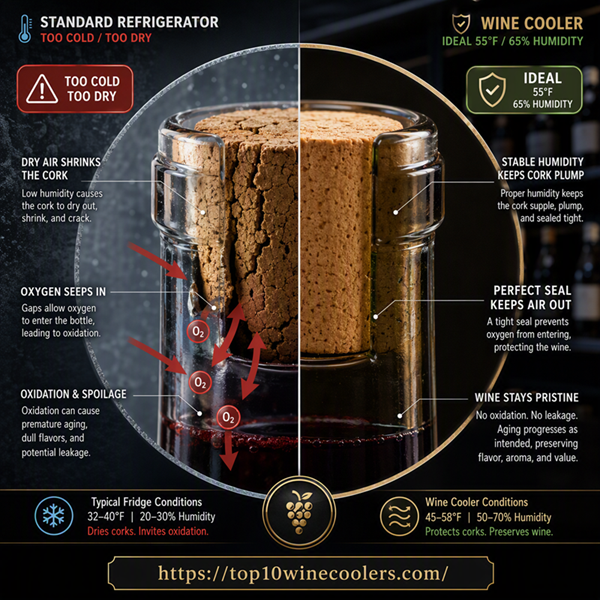
macro diagram of wine bottle neck comparing dry cork versus humidified sealed cork
Standard kitchen fridges create an environment that is too dry, causing corks to shrink and ruinous oxygen to seep into your wine investment.

Natural cork needs enough ambient moisture to remain resilient. In a very dry refrigerator, a cork may gradually dry and contract. Once that happens, oxygen can enter the bottle more easily, increasing the risk of premature aging, oxidation, or leakage.

This is especially relevant for collectors who buy wines to enjoy over several years: vintage reds, premium Bordeaux-style blends, Barolo, Brunello, collectible Napa Cabernet, and certain age-worthy whites. The longer you intend to keep those bottles, the more important their storage environment becomes.

Many wine refrigerators are designed to maintain a less dry environment than a typical food refrigerator. While humidity control varies by model, the enclosed, purpose-built cabinet and stable conditions are inherently more wine-friendly than a constantly cycling kitchen fridge.

It is worth noting that screwcaps and synthetic-cork wines are less sensitive to cork drying. Still, they benefit from stable temperatures, low vibration, and protection from light—so a wine fridge remains helpful for more than just corked bottles.

Vibration: How Compressor Cycles Agitate Fine Wine Sediment

Vibration is one of the most overlooked reasons why standard fridges ruin wine over time. Your refrigerator’s compressor cycles on and off all day, often alongside fans, ice makers, water dispensers, and the regular movement of a busy kitchen. Every cycle creates subtle vibration.

For an everyday bottle you plan to drink this weekend, that is unlikely to be a major concern. But for fine wine meant to rest and develop, constant movement is not ideal. Older red wines and unfiltered wines can develop delicate sediment as they age. Excessive agitation may keep that sediment suspended, making the wine cloudy or gritty when poured before it has had time to settle.

Vibration is also undesirable because wine is best stored quietly and consistently. The more stable the bottle, the more predictable its aging environment becomes.

A vibration dampening wine cooler is designed to minimize this problem. Premium models may use low-vibration compressor systems, insulated cabinet construction, rubberized mounts, or thermoelectric cooling technology in smaller units. While no appliance is completely vibration-free, purpose-built wine coolers reduce the constant mechanical disturbance common in a household refrigerator.

For collectors, that protection can matter most with older vintages, sediment-heavy reds, and bottles you are saving for meaningful occasions.

The Invisible Threat: Light Damage and UV Exposure

Light is another quiet threat to wine quality, particularly sunlight and ultraviolet exposure. Wines stored in clear or lightly colored bottles, including many white wines, rosés, and sparkling wines—are more vulnerable to light strike, a condition that can create muted aromas and unpleasant sulfur-like notes.

A standard refrigerator may seem dark most of the time, but its interior light turns on whenever the door opens. In a busy home, that can happen dozens of times per day. Bottles placed in a refrigerator door are exposed not only to light but also to the most dramatic temperature swings and vibration.

The greater concern, however, is where the refrigerator or wine cooler is located. A glass-front wine fridge positioned near a sunny kitchen window, patio door, or brightly lit entertaining space should have protective glass.

An UV protected glass wine fridge helps filter damaging ultraviolet rays while still allowing you to display your collection. Double-paned, tinted, or UV-resistant glass can also improve insulation, reducing the amount of temperature change caused by warm ambient air and sunlight.

For best results, place any wine appliance away from direct sun, ovens, dishwashers, and heating vents. UV-protected glass is a valuable layer of defense—not a reason to place a wine fridge in direct afternoon sunlight.

The Engineering Behind Premium Wine Preservation

A quality wine cooler is more than a compact refrigerator with a wine rack. Its features are designed around the conditions wine needs to remain stable, protected, and ready to enjoy.

Advanced Vibration-Dampening Systems Explained

The best wine refrigerators use engineering features that reduce mechanical disturbance. Depending on the model, that may include a low-vibration compressor, shock-absorbing mounts, insulated cabinet walls, or quiet fan circulation.

Thermoelectric wine coolers are often praised for their low-vibration operation because they do not use a traditional compressor. They can be an appealing option for small collections kept in a climate-controlled room. However, compressor-based units usually offer stronger cooling performance, particularly in warmer homes, garages, or busy kitchens.

For many buyers, the ideal balance is a modern compressor wine fridge designed with vibration reduction in mind. Brands such as EdgeStar and Allavino offer models with features aimed at stable, collector-friendly storage, though the right choice depends on your bottle count, room temperature, and desired installation style.

The Defense Power of Double-Paned UV-Protected Glass

Glass doors make it easier to see what you own, plan dinner parties, and avoid leaving the door open while searching for a bottle. But glass should also protect, not merely display your collection.

Double-paned UV-protected glass helps reduce exposure to ambient light while adding insulation. That insulation supports more stable internal temperatures, especially if your wine fridge is installed in a kitchen or entertaining area where the surrounding temperature changes throughout the day.

Look for terms such as “UV-resistant glass,” “tinted glass,” “double-pane glass,” or “Low-E glass” when comparing models. These features are particularly worthwhile if you want a display-style wine fridge rather than a fully solid-door cellar unit.

Why Wood Shelves Beat Metal Wire for Shock Absorption

Shelves may seem like a cosmetic detail, but they affect both bottle security and everyday usability. Metal wire shelves are common in budget refrigerators, yet they can feel less stable when pulled out and may not accommodate wider Champagne, Pinot Noir, or Burgundy bottles particularly well.

Wood-front or wooden wine shelves generally create a more refined, cellar-inspired storage experience. They can provide a steadier resting surface, help reduce bottle-on-metal rattling, and make it easier to access bottles without disturbing the rest of the collection.

They also elevate the look of the appliance. If your wine fridge will live in your kitchen, dining room, bar area, or living space, wood shelving helps it feel like part of your entertaining setup rather than another utilitarian appliance.
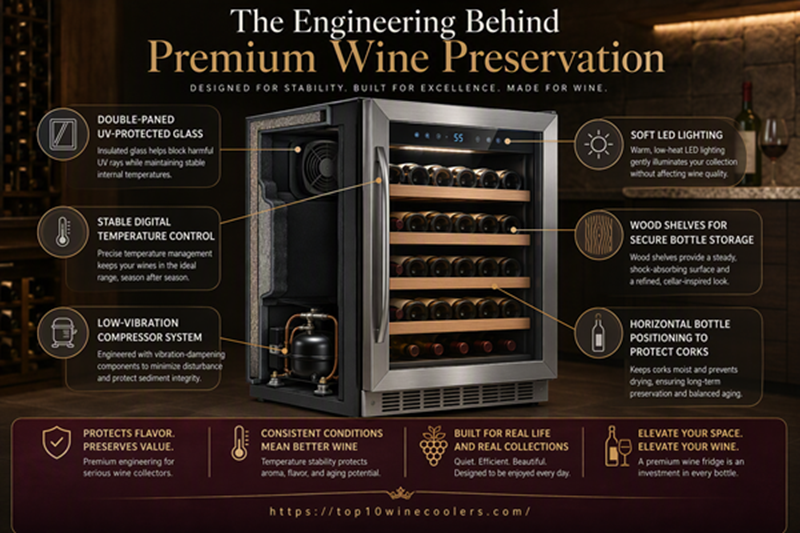
Wine fridge features including vibration dampening UV-protected glass and wood shelves
The Science Behind Premium Wine Preservation includes Advanced Vibration-Dampening Systems, UV-Protected Glass and Wood Shelves for Shock Absorption.

Why a Dedicated Wine Cooler Elevates Your Hosting Experience

A dedicated wine cooler protects your bottles, but it also makes hosting more relaxed. Instead of crowding your kitchen fridge with bottles before guests arrive, you can keep a ready-to-pour selection organized at proper serving temperatures.

A single-zone unit is often ideal if you primarily collect one style of wine or want one consistent storage temperature. A dual-zone model can be useful if you want crisp whites and sparkling wines chilled in one section while reds are kept slightly warmer in another. For a closer comparison, see our guide to Single-Zone vs. Dual-Zone Wine Coolers.

Capacity is equally important. A wine fridge that is too small fills quickly, especially once you account for wider bottles and the temptation to bring home a few extra favorites. For many households, a 40- to 50-bottle wine refrigerator offers a practical sweet spot: enough room to build a varied collection without overwhelming a kitchen or entertaining area. Use our Bottle Capacity Guide to calculate the size that makes sense for your buying habits.

Ultimately, a wine fridge is not an unnecessary luxury for someone who cares about wine. It is a practical preservation tool—and a way to protect the money, memories, and future dinners stored in every bottle.
Filed Under: Lifestyle of Entertaining

By Jackie Paley Leave a Comment

Single-Zone vs. Dual-Zone Wine Coolers: How to Choose for Your Collection

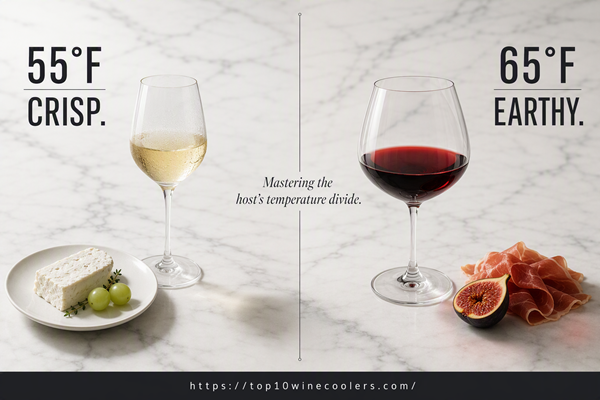
Picture this: Your guests have just arrived, the music is perfectly mixed, and the charcuterie board is set. Half of the room requests a crisp, vibrant Sauvignon Blanc, while the other half looks forward to an earthy, well-aerated Pinot Noir. As a host, serving both at their exact, sommelier-recommended temperatures is the ultimate mark of hospitality. But if you are working with a single cooling cavity, someone’s glass is going to suffer.


A split-screen minimalist kitchen scene showing a chilled glass of white wine at 55 degrees and an aerated red wine at 65 degrees on a white marble countertop.
Serving Sauvignon Blanc and Pinot Noir at their respective, sommelier-recommended temperatures.

Choosing between a single-zone and a dual-zone wine cooler is not just a technical decision about compressors. It is a direct reflection of how you collect, curate, and entertain. The right choice depends less on whether one configuration is “better” and more on what is actually in your collection, how quickly you drink through it, and whether your home bar is built for quiet weeknight pours or regular mixed-varietal gatherings.

Let’s break down your drinking and hosting habits to find the zone configuration that best elevates your wine experience.

The Basics: What Is the Difference

At the most basic level, a wine cooler is designed to keep bottles at a stable, wine-friendly temperature. It is usually warmer than a kitchen refrigerator and cooler than room temperature. The key distinction is whether the appliance has one independently controlled temperature area or two.

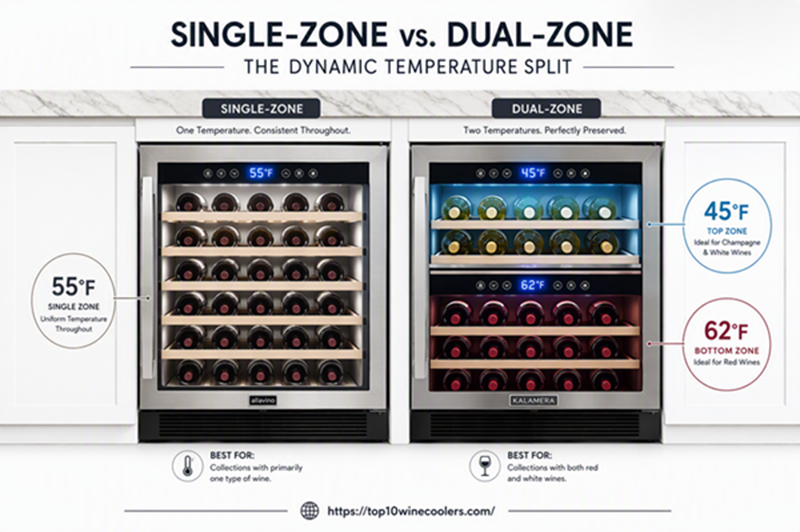
A single-zone wine cooler has one temperature setting for the entire cabinet. A dual-zone wine cooler has two separate compartments, each with its own temperature control range.

That sounds simple, but it changes how you can organize your bottles and how ready they are to pour when the occasion arises.


infographic comparing single zone and dual zone wine fridges under kitchen counter.

How Single-Zone Wine Fridges Work

A single-zone wine fridge uses one cooling cavity and one thermostat. Whether it holds 12 bottles, 30 bottles, or well over 100, the entire collection sits at the same selected temperature.

This is an excellent setup for collectors whose bottles have a similar purpose. For example, you may primarily cellar red wine for gradual aging, keep a rotating supply of Champagne at one preferred temperature, or collect one type of wine more heavily than others.

Single-zone coolers also work well when your goal is storage rather than immediate serving. Most wines intended for aging do well at a relatively stable temperature around 53–57°F. At that temperature, reds, whites, rosés, and sparkling wines can all be stored safely for the medium or long term. You may need to chill a white further before serving or let a red warm slightly after opening, but the bottles themselves are protected in a stable environment.

Because they use one temperature setting, single-zone units are generally simpler to operate. They are often less expensive than comparable dual-zone models and may offer more bottle capacity for the same physical footprint.

How Dual-Zone Wine Fridges Work

A dual-zone wine fridge divides the interior into two independently controlled sections. Depending on the design, the upper zone may be cooler than the lower zone, or either zone may be adjustable within a specified range.

This lets you keep different wines at different temperatures simultaneously. A common arrangement is to store or serve whites and sparkling wines in the cooler zone—often around 42–50°F, while keeping reds in the warmer zone, perhaps around 55–65°F.

For the wine hobbyist who drinks a mix of styles regularly, this convenience is the central appeal. You can open a chilled Albariño on a Tuesday night, reach for a lightly cooled Pinot Noir on Friday, and host a dinner party without moving bottles between a wine cabinet, refrigerator, and countertop.

However, it is important to understand that dual-zone cooling is not automatically better for every collection. The zones are usually separated by a divider rather than completely independent refrigeration systems, so the temperature difference between zones has limits. In many models, the upper and lower sections can differ by several degrees, but you should always check the manufacturer’s temperature ranges before buying.

Evaluating Your Wine Drinking and Entertaining Habits

Before comparing capacities, finishes, or digital controls, audit your real habits. Not the collector you imagine becoming someday—but the person who actually opens bottles in your home now.

Ask yourself a few practical questions:

  • What percentage of your collection is red, white, rosé, sparkling, or dessert wine?
  • Do you buy bottles to age, or do you typically drink them within weeks or months?
  • How often do you host friends or family?
  • When you entertain, do guests tend to drink different wine styles?
  • Are you comfortable chilling whites separately or warming reds briefly before serving?
  • Do you need a wine fridge to be a cellar, a serving station, or both?

💡Your answers will usually point clearly toward one configuration.

The Red-Only or White-Only Collector (Single-Zone)

A single-zone cooler is often the smartest choice for collectors with a focused buying pattern.

If your rack is filled mostly with Cabernet Sauvignon, Syrah, Bordeaux blends, Barolo, and other reds intended for gradual aging, one stable storage temperature is exactly what you need. Setting the cabinet around 55°F helps protect your bottles from the heat swings of a kitchen, garage, or living room while allowing the wines to mature at a controlled pace.

The same principle applies if you are a dedicated white-wine, sparkling-wine, or rosé drinker. If most of your bottles are Sauvignon Blanc, Chardonnay, Riesling, Prosecco, and Champagne, a single-zone cabinet set to a cooler temperature can keep your everyday choices close to serving-ready.

Single-zone storage is also ideal for the collector who values capacity. If you have limited floor space but want to keep a deeper reserve of similar wines, a larger single-zone unit may hold more bottles than a dual-zone model of comparable exterior dimensions. The absence of a second temperature section can make interior organization more straightforward too.

This option is especially attractive for people who see their wine cooler primarily as a cellar. You do not need every bottle at its final serving temperature all the time. You simply need a reliable place to preserve wine until the day you decide to open it.

The Varietal Enthusiast & Frequent Host (Dual-Zone)

A dual-zone wine cooler is designed for the person whose collection is diverse and whose wine is regularly part of entertaining.


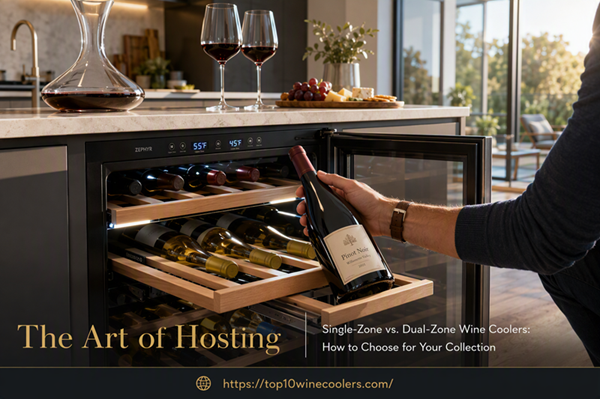
modern bright kitchen island with built in dual zone wine refrigerator door open.

Maybe you enjoy bold reds in colder months, but you also keep a steady supply of Sauvignon Blanc, Grüner Veltliner, and rosé for warmer weather. Maybe your partner prefers bubbly while you tend toward Pinot Noir. Or perhaps you host dinners where a seafood starter, a roast entrée, and a cheese course all call for different bottle styles.

In these situations, two temperature zones reduce friction. Whites and sparkling wines can remain chilled in one section, while reds stay slightly warmer in the other. Instead of planning ahead by transferring bottles into the refrigerator or leaving red wine on the counter, you can offer guests more choices at appropriate temperatures.

Dual-zone cabinets are particularly useful for “drink-now” collections. If you typically buy a bottle on the weekend and open it within a few months, serving convenience may matter more than maintaining a single uniform aging temperature.

They also make sense for collectors who want visual organization. You can dedicate one zone to whites, rosés, and sparkling wines, and the other to reds. That makes it easier to see what you have on hand and restock before a gathering.

The tradeoff is that you may sacrifice some usable capacity and pay more for the added controls. But for a mixed collection that is frequently opened and shared, the convenience can easily justify the difference.

Storage vs. Serving Temperature: The Ultimate Distinction

The biggest mistake shoppers make is treating storage temperature and serving temperature as though they are the same thing.

For long-term storage, most wine benefits from a stable environment around 55°F, with minimal vibration, controlled humidity, and protection from light. This applies broadly across red, white, sparkling, and dessert wines. Consistency is more important than chasing a perfect number; frequent temperature fluctuations are generally more concerning than being a degree or two above or below the ideal.

Serving temperatures are different because they influence how a wine tastes in the glass.

As a general guide:

  • Sparkling wines: about 40–45°F
  • Light, crisp whites and rosés: about 45–50°F
  • Fuller-bodied whites: about 50–55°F
  • Light reds, such as Pinot Noir: about 55–60°F
  • Medium- to full-bodied reds: about 60–65°F

Too-cold wine can taste muted, tight, or less aromatic. Too-warm wine can seem alcoholic, soft, and unbalanced. A Cabernet served straight from a 55°F storage cabinet may benefit from 15 to 25 minutes at room temperature, while a Sauvignon Blanc stored at 55°F may need additional chilling before dinner.

This is why the choice between single-zone and dual-zone comes down to purpose. If your wine fridge is primarily a cellar, a single temperature is often ideal. If it is primarily a ready-to-pour beverage station, dual zones are more useful.

A dual-zone cooler can handle both roles in a limited way, i.e. perhaps using one zone for longer-term storage and the other for bottles you plan to open soon. But serious collectors with substantial aging inventories sometimes choose a dedicated single-zone storage cabinet plus a smaller serving fridge for everyday bottles.

Crucial Features to Look for in Both Styles

Zone count matters, but it should not be the only feature guiding your purchase. Whether you choose one zone or two, the best wine cooler is one that protects your bottles, fits your space, and works with the shapes of bottles you actually buy.

Why UV-Protected Glass Matters Across All Zones

Wine’s enemies include heat, vibration, temperature swings, and light. Ultraviolet exposure can contribute to premature aging and “lightstruck” aromas, especially in wines bottled in clear or light-colored glass.

A wine cooler with UV-protected or double-pane tempered glass helps reduce light exposure while still allowing you to view your collection. This is particularly important if the unit will sit in a bright kitchen, dining room, living area, or near windows.

Glass-door coolers are popular because they turn wine storage into part of the room’s design, but the door should do more than look attractive. Look for tinted, UV-resistant glass and a tight door seal. An interior LED light is also preferable to heat-producing bulbs, and ideally it should switch off automatically rather than remain on all day.

Maximize Versatility with Adjustable Wooden Shelves

Bottle capacity claims can be misleading. Many manufacturers calculate capacity using standard Bordeaux-shaped 750 mL bottles. If your collection includes wide Burgundy bottles, Champagne bottles, unusual Rhône shapes, or larger-format bottles, the real capacity may be lower.

Adjustable or removable shelves make a major difference. Wooden shelves are especially popular because they help cradle bottles securely, reduce harsh rattling, and add a more traditional cellar-like look. More importantly, they allow you to reconfigure the cabinet as your collection changes.

In a dual-zone model, check how many shelves each zone has and whether both compartments can accommodate the bottle styles you prefer. A cooler that technically has two zones is less useful if the lower section cannot hold your favorite Pinot Noir or sparkling bottles without removing half the shelves.

Also consider shelf glide. Smooth pull-out shelves make it easier to read labels and access bottles without disturbing the rest of the collection. For wines you plan to age, minimizing unnecessary movement is a welcome bonus.

Pros and Cons of Each Configuration

Single-zone and dual-zone coolers both have clear advantages. The right choice depends on which compromises are easiest for you to live with.

Single-zone wine cooler advantages:

  • Usually lower purchase price at comparable capacity
  • Often offers more bottle storage in the same footprint
  • Simple operation with one temperature setting
  • Excellent for long-term storage at a stable temperature
  • Ideal for focused collections, especially red-heavy cellars

Single-zone wine cooler drawbacks:

  • Cannot keep reds and whites at separate serving temperatures
  • May require extra chilling or warming before serving
  • Less convenient for hosts serving multiple styles at once

Dual-zone wine cooler advantages:

  • Keeps different wine styles at different temperatures
  • Excellent for mixed collections and frequent entertaining
  • Makes whites, rosés, sparkling wines, and reds more readily available
  • Offers easy organizational separation between wine categories

Dual-zone wine cooler drawbacks:

  • Typically costs more than a similar single-zone model
  • May provide less total usable capacity
  • Zone temperature ranges can be limited by the model
  • Not always necessary for long-term aging collections

Price, Capacity, and Mechanics (Compressor vs. Thermoelectric)

The cooling system also affects performance. Most wine coolers use either compressor-based or thermoelectric technology.

Compressor wine coolers are generally more powerful and better suited to larger capacities, built-in installation, and warmer rooms. They can maintain their target temperature more reliably when the surrounding environment gets hot, which is useful in busy kitchens or homes without consistent climate control. Modern compressor units can be quite quiet, though they may produce more sound and vibration than thermoelectric models.

Thermoelectric wine coolers are often quieter and have fewer moving parts. They can be a good fit for small collections in temperature-controlled rooms, such as a home office or dining area. However, their cooling performance may be limited when the room becomes very warm. They are usually not the best choice for a hot garage, sunroom, or kitchen that receives intense afternoon sunlight.

Price is influenced by more than zone count. Built-in capable units, larger capacities, premium shelving, stainless-steel finishes, reversible doors, and better insulation can all raise the cost. Rather than buying the largest or most feature-packed model immediately, choose a cooler that matches both your current collection and your realistic near-term growth.

A good rule is to buy slightly more capacity than you think you need. Wine collections tend to expand, especially once you have a dedicated place to store bottles properly.

Which Zone Setup Fits Your Home Lifestyle?

Choose a single-zone wine cooler if you primarily collect one wine category, want to age bottles at a stable temperature, value maximum capacity, or do not mind making small serving-temperature adjustments before opening a bottle. A single zone wine fridge is the practical, efficient choice for the focused collector and the cellar-minded enthusiast.
Choose a dual-zone wine cooler if your collection is a genuine mix of reds, whites, rosés, and sparkling wines. It is the better fit for the host who wants to offer guests choices—and pour each choice at a temperature that lets the wine shine. If you entertain often, a dual-zone under counter wine cooler is an elegant and a functional appliance to configure into your kitchen, dining room or home bar.

Ultimately, do not buy based on the number of zones alone. Take inventory of what you drink, how quickly you drink it, and what your gatherings look like. A single-zone cabinet can be the perfect foundation for a thoughtful cellar, while a dual-zone model can turn your wine collection into a more flexible, guest-ready home bar.

The best wine cooler is the one that makes opening the right bottle easier—whether that means quietly aging a favorite Cabernet for years or effortlessly pouring cold Sauvignon Blanc and perfectly tempered Pinot Noir at the same dinner party.

Filed Under: Lifestyle of Entertaining

By Jackie Paley Leave a Comment

Complete Santa Barbara County Wine Tasting Guide: Scenic Drives, Pinot Noir, Chardonnay and Rhône-Style Wines

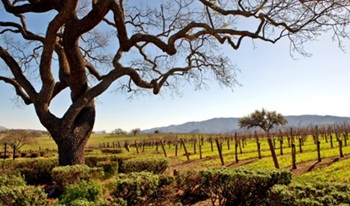
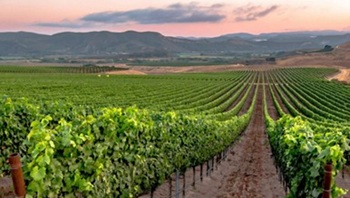
Santa Barbara County is one of California’s most rewarding wine destinations, especially for travelers who want more than a single tasting room stop. Here, wine country unfolds across beachside tasting rooms, walkable small towns, historic vineyards, ranch roads, fog-cooled hillsides and cinematic landscapes made famous by the movie Sideways.

This is a region where you can taste elegant Pinot Noir in the morning, sip crisp Chardonnay near the coast in the afternoon, and finish the day with Syrah, Grenache or a Rhône-style blend in a relaxed valley tasting room.top10winecoolers.com

It is also one of the most varied wine regions in California, offering everything from urban tasting rooms in the city of Santa Barbara to estate wineries tucked among the hills of the Santa Ynez Valley, Sta. Rita Hills and Santa Maria Valley.

Santa-Ynez-valley-wine-country

For wine travelers, Santa Barbara County is especially appealing because it combines scenic drives, charming towns and serious wine. You can plan a car-free tasting day along the Santa Barbara Urban Wine Trail, wander between tasting rooms in Los Olivos, follow the Sideways route through Buellton and Solvang, or seek out cool-climate Pinot Noir and Chardonnay from Sta. Rita Hills and Santa Maria Valley.

This guide introduces the major Santa Barbara County wine regions, the best wine styles to taste, suggested scenic routes and practical planning tips for building a memorable wine-country trip.

Table of Content – At A Glance:

Why Santa Barbara County Is One of California’s Most Exciting Wine Regions

Main Santa Barbara County Wine Regions to Know:

  • Santa Barbara County Wine Tasting Map
  • Santa Barbara Urban Wine Trail
  • Los Olivo
  • Santa Ynez Valley
  • Sta. Rita Hills
  • Santa Maria Valley

Best Scenic Wine Drives in Santa Barbara County:

  • Santa Barbara to Los Olivos
  • Buellton to Sta. Rita Hills
  • Santa Maria Valley and Foxen Canyon Road
  • Solvang, Santa Ynez and the Valley Loop

Best Areas for Pinot Noir and Chardonnay

Where to Taste Rhône-Style Wines in Santa Barbara County

Suggested Santa Barbara County Wine Itineraries:

  • One-Day Itinerary
  • Two-Day Itinerary
  • Three-Day Weekend Itinerary Inspired by Sideways

Tips for Planning a Santa Barbara Wine Tasting Trip:

  • Make Reservations When Possible
  • Do Not Overbook Tastings
  • Plan for Transportation
  • Think About Shipping or Storing Wine

Final Thoughts: Why Santa Barbara County Belongs on Every California Wine Travel List

Why Santa Barbara County Is One of California’s Most Exciting Wine Regions

Santa Barbara County has a distinctive geography that sets it apart from many other California wine regions. Instead of running north to south, several of its coastal mountain ranges and valleys run east to west. This unusual orientation allows cool Pacific air and fog to move inland, moderating temperatures and creating excellent conditions for cool-climate grapes.

That cooling influence is one reason Santa Barbara County has become especially respected for Pinot Noir and Chardonnay.

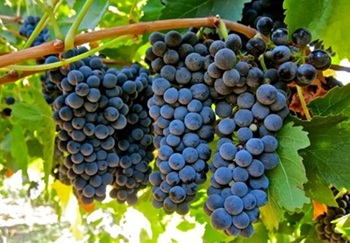
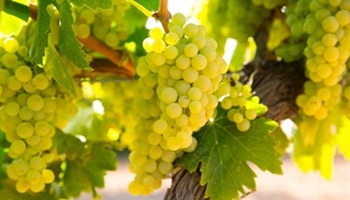
pinot-noir-grapes

In places like Sta. Rita Hills and Santa Maria Valley, the combination of coastal fog, afternoon breezes and long growing seasons helps grapes retain acidity while developing complex flavors. You might like to read our article “what’s special about Pinot Noir”.

But Santa Barbara County is not only about Pinot Noir and Chardonnay. Warmer interior areas and diverse microclimates also support excellent Syrah, Grenache, Mourvèdre and other Rhône varieties. This makes the county a compelling destination for wine lovers who want to taste across a wide spectrum of styles.

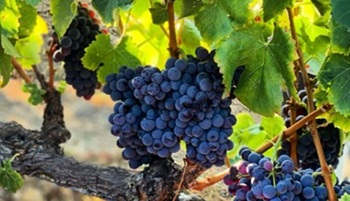
syrah-grapes

The region is also approachable. Compared with some of California’s larger and more commercial wine destinations, Santa Barbara County still feels personal, scenic and relaxed.
Many tasting rooms are small, friendly and conversational. The drives between towns are beautiful without being overwhelming. And the towns themselves — Santa Barbara, Solvang, Buellton, Los Olivos, Santa Ynez, Los Alamos and Santa Maria — each offer a different way to experience wine country.

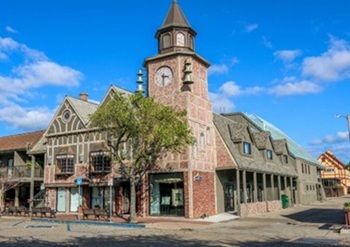
Solvang-clock-tower

For many visitors, the area’s wine identity is forever linked to Sideways, the 2004 film that helped introduce a broader audience to Santa Barbara County Pinot Noir. While the region has evolved enormously since the movie, the Sideways connection still adds a layer of fun to any wine weekend here.

Main Santa Barbara County Wine Regions to Know

Santa Barbara County is best understood as a collection of distinct wine areas rather than one single tasting destination. Each region has its own personality, wine styles and travel experience.

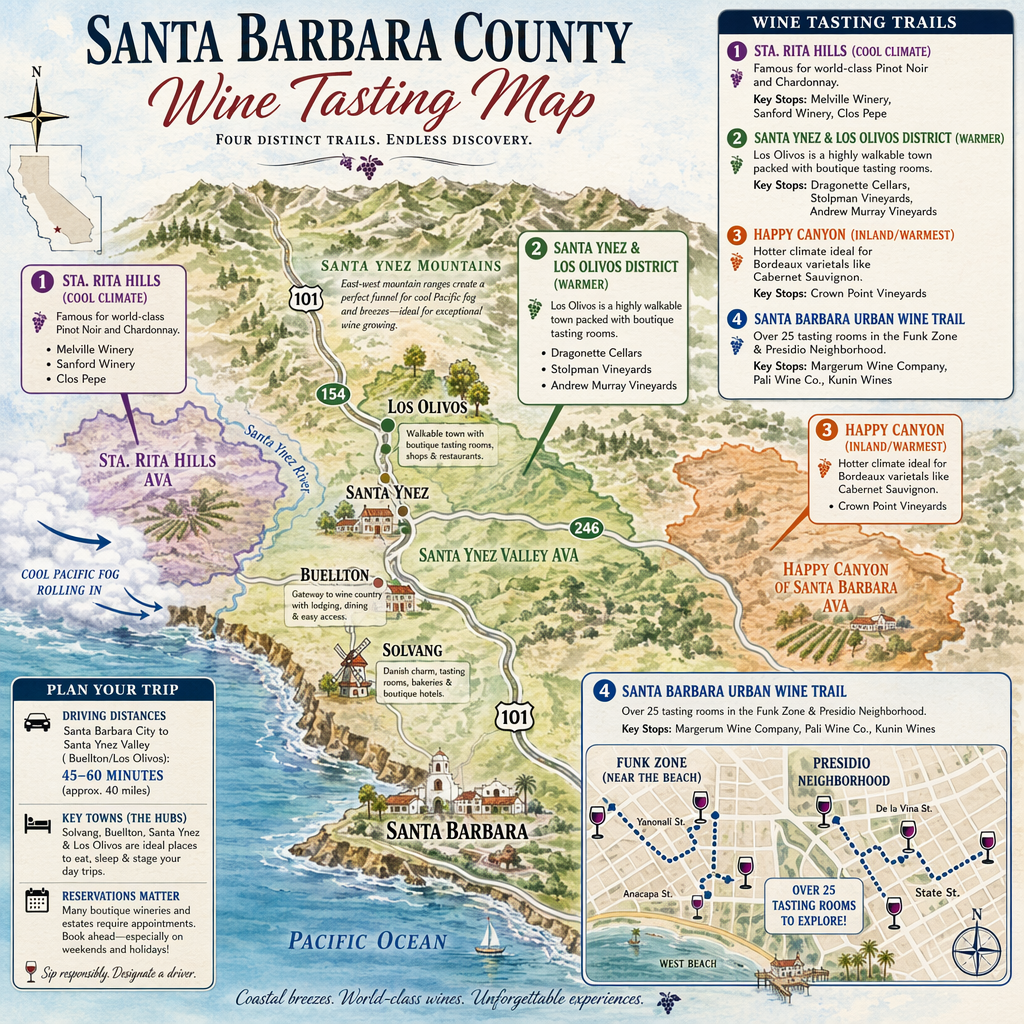
Santa Barbara County Wine Tasting Map

Santa-Barbara-County-wine-tasting-map-by-top10winecoolers
Santa Barbara County Wine Tasting Map by top10winecoolers.com

Santa Barbara Urban Wine Trail

The Santa Barbara Urban Wine Trail is ideal for travelers who want to taste wine without committing to a full day of driving. Located in the city of Santa Barbara, the trail includes tasting rooms clustered around neighborhoods such as the Funk Zone, waterfront area and historic Presidio district.

The Funk Zone is especially popular for its walkable, beach-adjacent energy. Visitors can move between tasting rooms, restaurants, art galleries and breweries, all within a compact neighborhood close to the ocean. Tasting rooms such as Margerum Wine Company, Pali Wine Co. and other local producers give visitors access to wines sourced from vineyards across the county.

Santa-Barbara-Urban-Wine-Trail

The Presidio area offers a slightly different mood, with historic architecture, downtown charm and tasting rooms such as Grassini Family Vineyards and Jamie Slone Wines. For travelers staying in Santa Barbara, the Urban Wine Trail is one of the easiest and most enjoyable introductions to the county’s wine scene.

Los Olivos

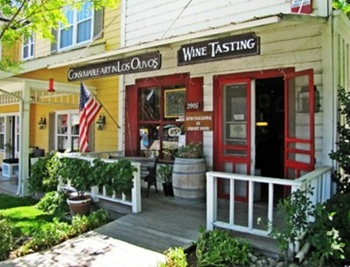
Los Olivos is one of the most beloved wine towns in California. Small, charming and highly walkable, the town center is lined with tasting rooms, restaurants, boutiques and galleries. It is possible to park once and spend an entire afternoon tasting wines from different producers without getting back in the car.

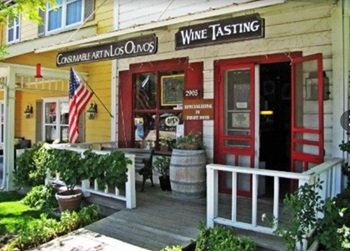
Los-Olivos-wine-tasting

This makes Los Olivos especially useful for travelers who want variety. Instead of driving between vineyard estates, visitors can compare Pinot Noir, Chardonnay, Syrah, Grenache, Sauvignon Blanc and Rhône-style blends from multiple producers in a single compact area.

Tasting rooms to consider include Dragonette Cellars and Stolpman Vineyards, both of which help showcase the quality and range of Santa Barbara County wines. Los Olivos also makes a convenient base or afternoon stop when exploring the larger Santa Ynez Valley.

Santa Ynez Valley

The Santa Ynez Valley is one of the central wine regions of Santa Barbara County and includes several important towns and communities, including Los Olivos, Solvang, Santa Ynez, Buellton and Ballard. The valley offers a classic wine-country mix of scenic drives, tasting rooms, vineyard estates, ranch landscapes and small-town hospitality.

Santa-Ynez-Valley-winery

This is where visitors can combine walkable tasting with destination wineries. A day might begin with breakfast in Solvang, continue with tasting rooms in Los Olivos, and end with an estate visit at Fess Parker Winery or Sunstone Winery.

The Santa Ynez Valley is also an excellent place to explore Rhône-style wines. Syrah, Grenache and blends thrive in parts of the valley, particularly where warmer days and cool nights support both ripeness and balance.

Sta. Rita Hills

Sta. Rita Hills is one of the most important cool-climate wine areas in California. Located between Buellton and Lompoc, this region is famous for Pinot Noir and Chardonnay grown under the influence of ocean fog, wind and marine-cooled conditions.

Sta-Rita-Hills-acclaimed-American-viticultural-area

For visitors who love precise, elegant, aromatic wines, Sta. Rita Hills is essential. The region’s Pinot Noir can show red fruit, spice, earth and bright acidity, while Chardonnay often ranges from crisp and mineral to textured and barrel-influenced.

Sta-Rita-Hills-wineries

Wineries such as Melville Winery and Sanford Winery are closely associated with the region’s reputation. A visit to Sta. Rita Hills often feels more rural and vineyard-focused than tasting in Santa Barbara or Los Olivos, making it ideal for travelers who want to experience the landscape behind the wines.

Santa Maria Valley

Santa Maria Valley is another historic cool-climate region, particularly known for Chardonnay and Pinot Noir. Located farther north in Santa Barbara County, it offers a quieter, more agricultural wine-country experience compared with the more compact tasting towns of the Santa Ynez Valley.

Santa-Maria-Valley-Wine-Trail

The valley’s cool conditions and long growing season are well suited to Chardonnay, which can show freshness, citrus, orchard fruit, minerality and structure. Pinot Noir also performs well here, often with a slightly different profile than wines from Sta. Rita Hills.

Riverbench Vineyards is one producer to consider when exploring Santa Maria Valley. Depending on the itinerary, visitors may combine Santa Maria Valley with Foxen Canyon, Los Alamos or a longer north-county wine drive.

Best Scenic Wine Drives in Santa Barbara County

One of the great pleasures of Santa Barbara County wine tasting is the driving. The distances are manageable, the scenery changes quickly, and the routes connect beach, mountains, ranchland, vineyards and historic towns.

Santa Barbara to Los Olivos

The drive from Santa Barbara to Los Olivos is one of the best introductions to the county. Visitors leave the coast and cross the mountains into the Santa Ynez Valley, where the landscape opens into rolling hills, oak trees, horse ranches and vineyards.

Driving-to-Los-Olivos

This route works well for a day trip from Santa Barbara. You can spend the morning on the Urban Wine Trail, drive to Los Olivos for an afternoon of tasting, and return to Santa Barbara for dinner. Alternatively, Los Olivos can be the starting point for a longer valley weekend.

Buellton to Sta. Rita Hills

For Pinot Noir and Chardonnay lovers, the drive from Buellton toward Sta. Rita Hills is a highlight. This route moves into cooler, wind-influenced vineyard country where the marine layer plays a major role in grape growing.

Driving-to-Buellton

This is also a natural route for Sideways fans, since Buellton and the surrounding area are closely tied to the film. Visitors can combine movie nostalgia with serious wine tasting at Sta. Rita Hills estates.

Santa Maria Valley and Foxen Canyon Road

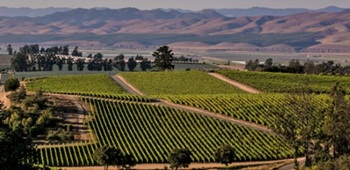
For a more rural, expansive drive, the Santa Maria Valley and Foxen Canyon area offer vineyard views, ranchland and a quieter pace. This route is especially appealing for travelers who want to understand the agricultural heart of northern Santa Barbara County.

Driving-to-Foxen-Canyon-area-vineyard-views

Because distances can be longer in this part of the county, it is wise to plan appointments carefully and avoid overbooking.

Solvang, Santa Ynez and the Valley Loop

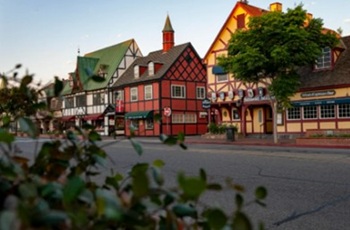
The area around Solvang, Santa Ynez and Los Olivos is ideal for travelers who want a scenic but easygoing route. Solvang offers Danish-style architecture, bakeries, hotels and restaurants, while nearby Santa Ynez has a western, historic feel. Los Olivos adds concentrated tasting rooms, and the surrounding roads lead to estates and vineyard properties.

Driving-to-Solvang-scenic-and-easygoing-route

This is one of the best loops for first-time visitors because it combines scenery, towns, food and wine without requiring too much driving.

Best Areas for Pinot Noir and Chardonnay

Santa Barbara County is one of California’s signature regions for Pinot Noir and Chardonnay. These grapes thrive in the county’s cooler zones, where fog, wind and marine influence help preserve acidity and aromatic complexity.

Sta. Rita Hills

Sta. Rita Hills is the standout destination for Pinot Noir and Chardonnay. The wines here often show energy, freshness and structure, making them appealing both for immediate enjoyment and for careful cellaring.

Sta-Rita-Hills-standout-destination-for-Pinot-Noir-Chardonnay

Pinot Noir from Sta. Rita Hills may show red cherry, raspberry, cranberry, spice, floral notes, earth and savory complexity. Chardonnay may range from lean and citrus-driven to richer styles with texture, oak influence and aging potential.

For serious collectors, Sta. Rita Hills is one of the best parts of Santa Barbara County to buy multiple vineyard-designate bottles. If you plan to build a collection from this trip, it is worth thinking ahead about proper wine storage at home. Read our selection of best under counter wine coolers to preserve your vintage collection.

Santa Maria Valley

Santa Maria Valley is another essential area for Chardonnay and Pinot Noir. Chardonnay is especially important here, with styles that can be crisp, mineral, fruit-driven, barrel-aged or sparkling depending on the producer.

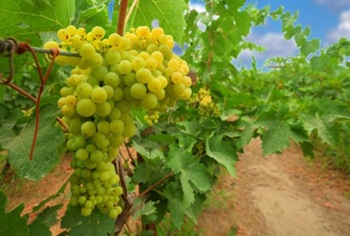
Chardonnay-grapes

The valley’s long growing season helps create wines with both flavor development and acidity. For visitors who enjoy comparing regional differences, tasting Chardonnay from Santa Maria Valley alongside Chardonnay from Sta. Rita Hills can be one of the most educational parts of a Santa Barbara wine trip.

Urban and Walkable Tasting Rooms

Even if you do not visit every vineyard region, you can still taste Pinot Noir and Chardonnay from across the county in Santa Barbara and Los Olivos tasting rooms. This is one advantage of the Urban Wine Trail and Los Olivos: both allow visitors to sample wines sourced from different appellations without driving to every vineyard.

Walkable-Tasting-Rooms-in-Los-Olivos

For travelers with limited time, this can be the most efficient way to understand Santa Barbara County’s cool-climate wines.

Where to Taste Rhône-Style Wines in Santa Barbara County

While Pinot Noir and Chardonnay receive much of the attention, Santa Barbara County is also an exciting region for Rhône-style wines. These include red grapes such as Syrah, Grenache and Mourvèdre, as well as white grapes such as Viognier, Roussanne and Marsanne.

Viognier-grape-variety

Santa Ynez Valley and Ballard Canyon

The Santa Ynez Valley, including areas around Ballard Canyon, is particularly important for Rhône varieties.

Warmer daytime temperatures allow grapes such as Syrah and Grenache to ripen, while cool nights help preserve balance and freshness.

Grenache-grapes

Syrah from Santa Barbara County can range from dark, savory and peppery to plush and fruit-forward. Grenache often brings red fruit, spice and brightness. Blends may combine structure, aromatics and richness in ways that make them excellent with food.

Los Olivos Tasting Rooms

Los Olivos is one of the easiest places to explore Rhône-style wines because several tasting rooms pour Syrah, Grenache and blends. Stolpman Vineyards and Dragonette Cellars are two names to consider when planning a Rhône-focused tasting afternoon.

wine-tasting-room-los-olivos

Santa Barbara Urban Wine Trail

The Urban Wine Trail can also be a convenient way to taste Rhône-style wines without leaving the city. Producers such as Margerum Wine Company may offer bottlings that showcase the county’s range beyond Pinot Noir and Chardonnay.

wine-tasting-room-midtown-Santa-Barbara-Urban-Wine-Trail

Suggested Santa Barbara County Wine Itineraries

Santa Barbara County works for many types of trips, from a single tasting afternoon to a long weekend. The key is choosing a route that matches your travel style.

One-Day Itinerary

If you only have one day, choose either a city-based or valley-based itinerary.

For a no-driving option, stay in Santa Barbara and explore the Urban Wine Trail. Start in the Funk Zone, enjoy lunch near the waterfront, then continue to the Presidio Neighborhood or downtown tasting rooms.

For a valley option, drive to Los Olivos and spend the day walking between tasting rooms. This gives you access to a wide variety of producers and styles without needing to drive between each stop.

Two-Day Itinerary

With two days, pair Santa Barbara with the Santa Ynez Valley.

Day one can focus on the Santa Barbara Urban Wine Trail, including the Funk Zone and Presidio area.

Day two can take you over the mountains to Solvang, Los Olivos and one vineyard estate such as Fess Parker Winery or Sunstone Winery.

This itinerary works well for couples or groups who want a mix of beach, city, small-town charm and vineyard scenery.

Three-Day Weekend Itinerary Inspired by Sideways

For a longer weekend, build a Sideways-inspired route through Santa Barbara County.

Start in Santa Barbara with the Urban Wine Trail. On day two, head to Buellton, Solvang and Sta. Rita Hills for Pinot Noir and Chardonnay. On day three, spend time in Los Olivos and the Santa Ynez Valley, adding Rhône-style wines or an estate winery visit before returning to the coast.

This itinerary captures the spirit of the movie while also showing how much the region has grown as a wine destination.

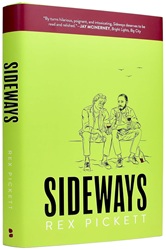
The-novel-Sideways-inspired-the-film-of-the-same-name

View on Amazon

Sideways is the story of two friends, Miles and Jack – going away together for the last time to steep themselves into everything that makes it good to be young and single:

Pinot, putting, and prowling bars.

Their trip centers around the Santa Ynez Valley wine country – route through Buellton and Solvang, seeking out cool-climate Pinot Noir from Sta. Rita Hills and Santa Maria Valley.

This raucous and surprising novel – inspired the film of the same name, starring Paul Giamatti.

Tips for Planning a Santa Barbara Wine Tasting Trip

A successful Santa Barbara County wine trip depends on pacing. The region is easy to explore, but it is still important to plan realistically.

Make Reservations When Possible

Many tasting rooms accept walk-ins, especially in urban or town-center locations, but reservations are still a good idea for popular weekends, estate wineries and smaller producers.

Always check current hours before visiting, since tasting room schedules can change seasonally.

Do Not Overbook Tastings

Two to three tasting appointments in a day is usually enough, especially if you are driving. Build in time for lunch, scenery, shopping, photos and unplanned discoveries.

Choose a Base That Matches Your Trip

Santa Barbara is ideal for beach, restaurants and the Urban Wine Trail.

Solvang and Buellton are convenient for Sta. Rita Hills and the Santa Ynez Valley.

Los Olivos is excellent for walkable tasting.

Santa Maria or Los Alamos may make sense for a north-county itinerary.

Plan for Transportation

If your itinerary involves rural wineries, designate a driver or consider hiring a wine tour service. If you are staying in Santa Barbara and focusing on the Urban Wine Trail, walking and rideshare options may be enough.

Think About Shipping or Storing Wine

It is easy to buy more wine than expected during a Santa Barbara County trip.

If you plan to bring home only a few bottles, a small wine refrigerator may be sufficient for short-term storage. If you expect to collect Pinot Noir, Chardonnay or Rhône-style reds over time, a dual-zone under counter wine refrigerator or a larger-capacity wine fridge may be a better investment for your home.

Final Thoughts: Why Santa Barbara County Belongs on Every California Wine Travel List

Santa Barbara County offers one of the most complete wine travel experiences in California. It has the beauty of a coastal destination, the charm of small wine towns, the seriousness of world-class vineyards and the relaxed hospitality that makes tasting feel personal.

Few regions make it so easy to build different kinds of wine trips. You can spend a weekend walking between tasting rooms in Santa Barbara and Los Olivos. You can follow a scenic route through Solvang, Buellton and the Santa Ynez Valley. You can focus deeply on Pinot Noir and Chardonnay in Sta. Rita Hills and Santa Maria Valley. Or you can explore the county through Syrah, Grenache and Rhône-style blends.

For first-time visitors, Santa Barbara County is approachable and scenic. For experienced wine lovers, it offers enough diversity and quality to reward repeated trips. And for anyone inspired by Sideways, the region still delivers that memorable mix of wine, landscape, food, friendship and discovery.

Whether you are planning a single tasting day or a full wine-country weekend, Santa Barbara County deserves a place near the top of your California wine travel list.

Cheers!

Filed Under: Santa Barbara County Wine Tasting, Wine Regions

By Jackie Paley Leave a Comment

Home Bar Ideas – 6 stylish and functional designs

You want to create a practical home bar space that looks good. And, you have a great sense of style – you know what colors, lighting and material to complement your overall home décor. Yes, you may be able to create a functional and beautiful home bar space on your own.

wine-and-home-bar-idea-by-top10winecoolers

Do I need an interior decorator to design a home bar?

It is not necessary to have an interior decorator to design a home bar. But if you have the budget, an interior decorator can help you create a cohesive design with a professional touch.

Architecture-blueprint-for-a-home-bar-layout

 Tip:  Check out resources available online, including how-to videos, and product reviews. They can provide insights into designing a home bar that meets your needs, and fits your personal style.

Six ideas for a home bar layout

Here are our six most popular home bar configurations ideas:

1. L-Shape

This layout is ideal for a corner space and is perfect for a small to medium-sized home bar.

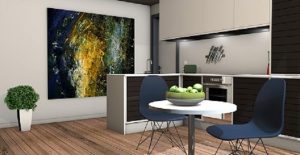
Example-of-a-L-shape-modern-kitchen-bar

 Tip:  The L-shape provides ample counter space and storage.

2. Straight Bar

This layout is a simple, classic design that can be any length. A straight bar is a good option for a narrow space or if you have limited counter space.

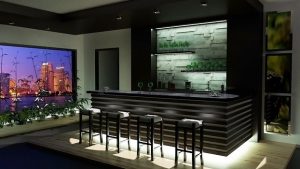
Tips-to-design-a-home-bar

 Tip:  Consider installing a wall-height appliance on one side of your room. For example, a freestanding tall wine fridge that can hold 100 plus bottles of wine.

3. U-Shape

The U-shape configuration provides ample counter space and storage, making it a great choice for a larger home bar.

Example-of-a-U-shape-home-bar

 Tip:  This layout is ideal for entertaining a group of people.

4. Island

An island bar is a stand-alone structure that is perfect for a large home bar. It provides ample counter space and storage.

Example-of-a-island-wet-bar

 Tip:  the island layout has an added bonus of being able to entertain guests from all sides.

5. Built-In

A built-in bar is a custom solution that is integrated into the design of your home. This type of bar can be any shape or size.

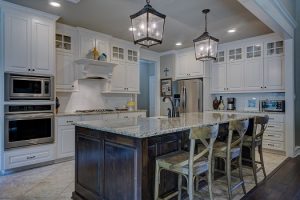
Example-of-a-built-in-kitchen-home-bar

 Tip:  the above layout can be built to match the existing cabinetry in your home for a cohesive design.

6. Wet Bar

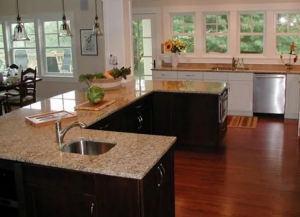
A wet bar includes a sink, making it a great option for mixing drinks. It can be integrated into a larger home bar configuration or used as a standalone feature. Here is an example of a 14-inch by 14-inch bar sink (view on Amazon):

wet-bar-sink-made-of-stainless-steel

 Tip:   when shopping for a bar sink, choose an undermount unit to give you more counter space. For durability and easy of cleaning, choose a bar sink constructed of premium stainless steel.

What features to consider when designing a home bar?

When designing a home bar, here is a helpful checklist including important features to consider:

  • Space: Determine the amount of space you have available for the bar and make sure it is adequate for your needs. Consider factors such as bar top height, bar stool height, and storage.  Tip:   allocate at least 42-inches minimum for walkway space between counters.
  • Layout: Consider the flow and functionality of your bar.  Tip:   you’ll want to make sure there is enough counter space for mixing drinks, and that the refrigerator, sink, and storage are easily accessible.
  • Lighting: Good lighting is important for a home bar.  Tip:   consider task lighting for the bar top, as well as ambient lighting for the surrounding area.
  • Storage: Consider how you will store your wine, wine glasses, liquor, mixers and barware.  Tip:   Built-in shelving, bar cart, wine racks, cabinets, or beverage refrigerators can provide convenient storage solutions.
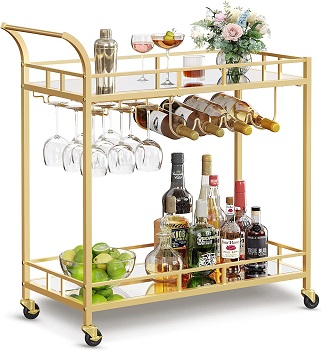
  • Here’s a freestanding bar-cart (view on Amazon) – a great way to bring flexibility to your home bar. It can be moved around, and you can bring this portable unit with you when you move.

    freestanding-bar-cart-flexibility-to-home-bar

  • Materials: Choose materials that are durable and easy to clean, such as granite or quartz for the bar top, and wood, stainless steel, or glass for the cabinetry.
  • Style: Consider the overall style of your home and choose a bar design that complements it. You can opt for a traditional, classic style or a more modern, minimalist look.
  • Appliance: Think about what bar equipment you’ll need, such as a wine cooler fridge, an under-counter beverage refrigerator and a countertop ice machine.
  • Bar tools: Consider a blender, a cocktail shaker, a strainer, a small cutting board, a wine bottle opener, a beer bottle opener, paring knives and ice tongs as useful barware tools.
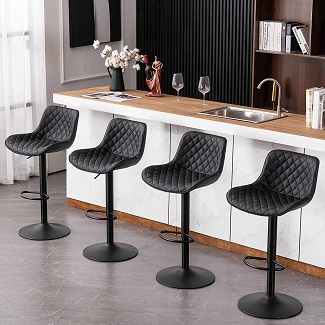
  • Seating: Choose seating that is comfortable and fits the style of your bar. Bar stools are popular options, but you can also consider comfortable chairs or a sofa?
  • Here’s an example of a swivel barstool (view on Amazon) – it gives you the options to adjust the height, and ability to swivel the chair.

    adjustable-swivel-bar-stools

     Tip:   when shopping for a bar stool, choose material that is easy to clean (waterproof is a good idea). Make sure the design matches with the look you want for your home bar.

Final Thoughts

We hope you are inspired by our six ideas for a home bar layout – they are popular options with our clients. The best one for you though – will depend on your specific needs and the available space in your home.

When you are ready to start your design of a home bar, use our feature checklist to help you organize your budget and shopping list.

Example-of-a-wine-and-liquor-bar-at-home

With careful planning, you can create a bar that is functional, stylish, and perfect for entertaining.

Filed Under: Home bar

  • Page 1
  • Page 2
  • Page 3
  • Go to Next Page »

Footer

Amazon Affiliate

We are a participant in the Amazon Services LLC Associates Program, an affiliate advertising program designed to provide a means for us to earn fees by linking to Amazon.com and affiliated sites.

We appreciate your support

When you purchase from Amazon using our affiliate links, it helps us to keep our site running and to continue providing you with our reviews, tips and guides on wine cellaring options. Thank You.

About Us

Contact Us

Disclaimer

Latest Wine Posts

  • Wine Fridge vs. Regular Refrigerator: Why Wine Needs a Dedicated Home
  • Single-Zone vs. Dual-Zone Wine Coolers: How to Choose for Your Collection
  • Complete Santa Barbara County Wine Tasting Guide: Scenic Drives, Pinot Noir, Chardonnay and Rhône-Style Wines
  • Home Bar Ideas – 6 stylish and functional designs
  • What is special about Cabernet Sauvignon

Copyright © 2026 · Top 10 Wine Coolers· All Rights Reserved