This buying guide provides you with the information and selection criteria to find the right wine fridge for your needs.

Fun Note: I’m thinking of the words of George R. R. Martin in The Mystery Knight — “Wine makes all things possible”, my goal here is create an approachable guide that makes buying a wine cooler not only possible but easy and rewarding.
The difference between wine fridge vs standard refrigerator?
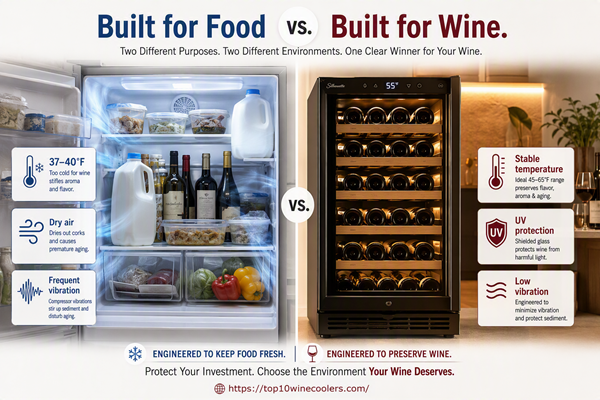
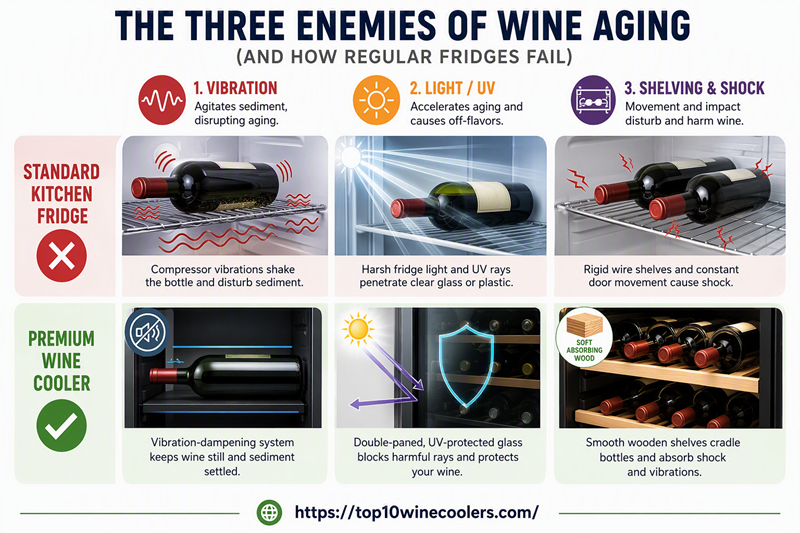
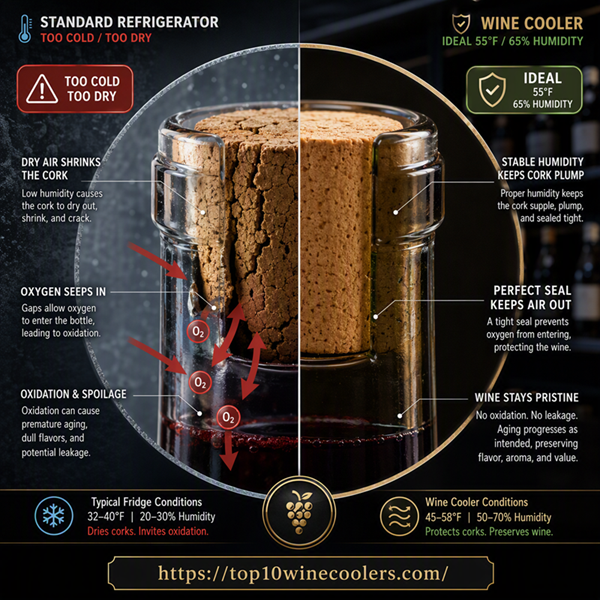
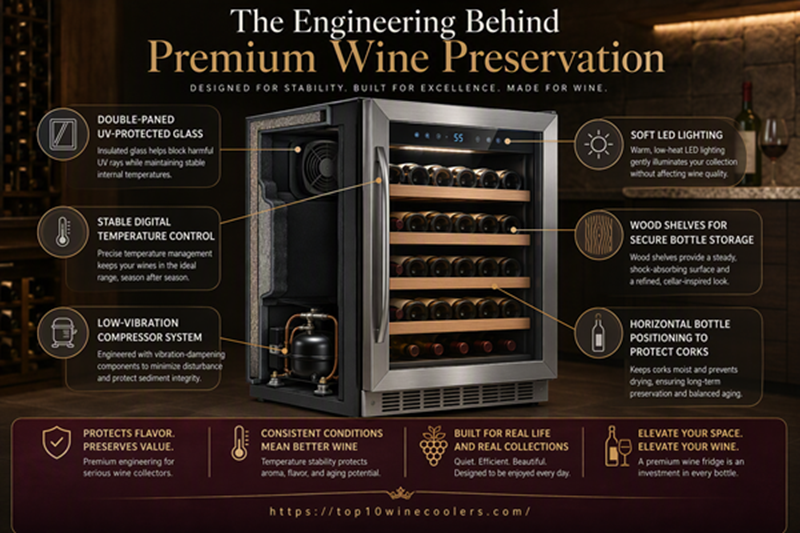
The most important difference between a wine fridge and a regular refrigerator is simple: a kitchen refrigerator is designed to slow food spoilage, while a wine fridge is designed to preserve wine’s flavor, structure, and aging potential.
- First let’s talk about the interior temperatures of refrigerators versus wine coolers.
- Second is the rack shelving inside a wine fridge vs. a food refrigerator:
Refrigerator – According to FDA guidelines, the proper temperature for a food refrigerator should be below 40°F. Why? because there is a higher chance of bacteria to grow at temperature higher than 40°F.
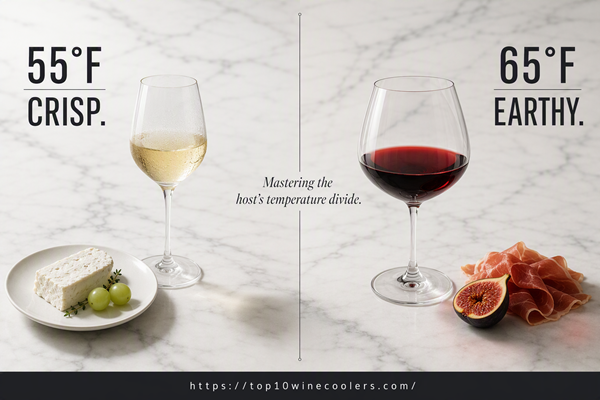
Wine coolers – They typically have a range of 40°-65° F. In general, store your white within a range of 40°-50°F, your red wine within a range of 55°-65°F. For long-term storage, 55°F is often chosen by wine collectors.
So, as you can see, the temperature in a food refrigerator (below 40°F) is too cold to store red wines and most dry white wine. That’s why we want a wine cooler to store wines in their proper temperatures.

Wine coolers have the correctly-designed shelving to cradle your wine bottles horizontally, and they allow proper air flow and humidity for your vintages. Food refrigerator is not designed to store your vino collection properly.
9 Important factors to consider when shopping for a wine fridge for your needs
Here is our easy and approachable guide to shop for an ideal wine storage for your home:
1. Capacity – how many bottles?
Obviously you want your wine cooler to be large enough to store your wine collection. Wine coolers can vary in size from 6 to 300+ bottles capacity. If you are a serious collector and have room, you may want a capacity of several hundred bottles of wine. If you live in an Airstream trailer, an eight bottle cooler may be all you can fit.
2. Installation types – what are the different types of a wine fridge?
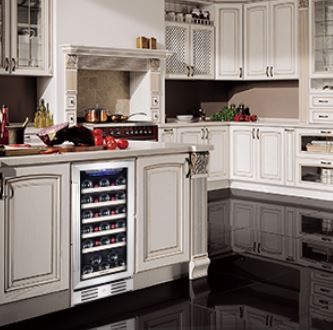
A wine cooler may be installed as freestanding, built-in or under a counter, or on top of a counter
- A small freestanding wine cooler can sit on your counter.
- A large stand-alone wine cellar can be freestanding on the floor in your kitchen or your home bar. Since freestanding wine coolers may be viewable from all sides, the design and finish are important considerations.
- Built-in wine coolers are those that are intended to be permanently built into your cabinetry. Built-in under-counter models are very popular among home owners. It’s important to know that not all wine coolers can be built-in. Built-in coolers always have compressor-based cooling and front-vent design.
- Note: Built-in wine coolers are typically viewed from the front. So, some built-in are not stylistically finished on the other sides of the appliance.
- Note: Many built-in do have finished exteriors – these fully-finished coolers will look good to install as free-standing units.
- Wine storage rooms that become structurally part of your house or business. While these can be fun, discussion of those is beyond the scope of this website. A friend in Geneva, Switzerland, where bomb shelters are required in all new construction, had converted his bomb shelter into a very elegant wine cellar and tasting room. He had the advantage of knowing that, in the worst case, he would enjoy his days in the bomb shelter.
3. Dimensions – what is the standard size of a wine fridge?
- A small cooler, 12-bottle, that sits nicely on the counter typically has a dimension of 17″ W x 18.5″ L x 20″ H (recessed handle)
- A medium-size cooler, 45-bottle, that sits seamlessly under counter generally has a dimension: 33 “H x 23.4 “W x 22.4″D (without handle); 33 “H x 23.4 “W x 24.4″D (with handle).
- A tall wine fridge, 100-bottle, that is free-standing commonly has a dimension: 23.54″ W x 22.5″ D x 55″ H (without handle); 23.54″ W x 24.75″ D x 55″ H (with handle).
Decide where will the cooler will be placed? Do you want it to sit on a counter-top? Do you want it to slide under-counter? Do you want a free-standing unit? Or do you want a wine cooler that occupies a more substantial space with concomitantly larger capacity?
How large a space do you have available for your wine cooler? Measure the space in which you plan to house your wine cooler
Make sure there is adequate room for ventilation – if you are installing a built-in, you want to allow two inches on all sides and the top.
4. Temperature Zones
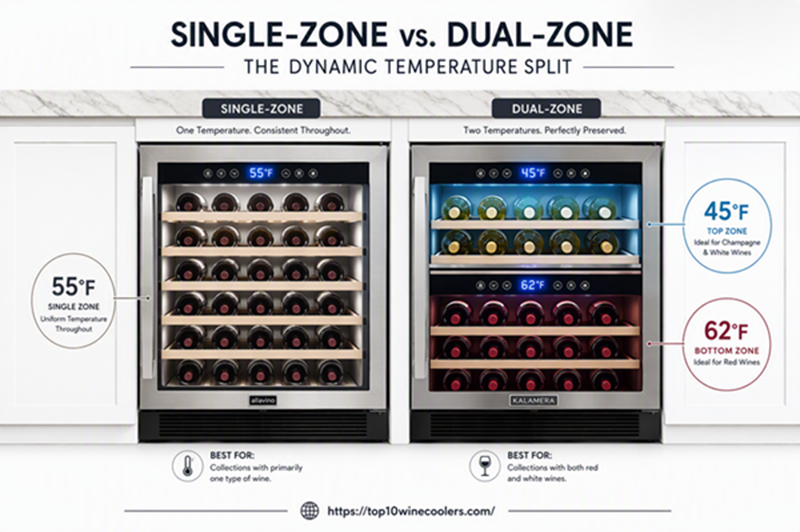
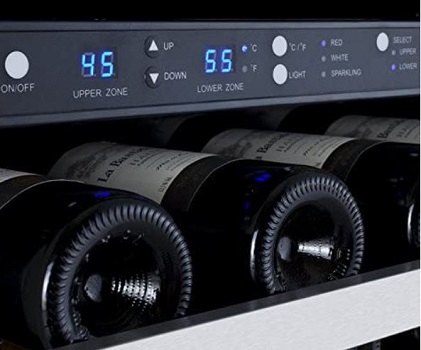
- Do you want a single zone or dual zone wine cooler? The zones refer to temperature zones.
- Typically wine coolers maintain a significantly warmer temperature than conventional refrigerators, but they may maintain a single temperature throughout (called single zone), or they may have two different areas with two different temperatures (called dual zone).
- Storing reds, whites, or both? Often collectors prefer that different types of wines be stored at different temperatures for proper bouquet and preservation. Learn the the differences between single and dual-zone wine fridges to choose the perfect cooling setup for your entertaining lifestyle..
5. Cooling systems
- Wine coolers use two kinds of cooling technologies – most use a compressor (like a home refrigerator), while others use Thermoelectric cooling.
- Each cooling type has advantages and disadvantages:
- A compressor will easily cool your wine and is a well-tested and reliable technology. The downside is that compressor wine coolers tend to be a bit noisier and to have a bit of vibration.
- Thermoelectric wine coolers are generally quieter and with no vibration. They may not cool as efficiently as a compressor-based cooling system. Thermoelectric system uses the Peltier effect to create a heat pump between two plates. The effectiveness of it depends on external temperature. Most thermoelectric wine coolers require ambient temperature range of 50°F-80°F. Another limitation is the size – in the market today, the maximum capacity of thermoelectric wine cooler available is 32-bottle.
6. Styling of wine coolers
- Often a key choice factor for a wine cooler is the styling of that cooler.
- Do you want stainless steel? Do you want smoked glass?
- Do you want cool LED lighting to show off your collection? Blue interior light? Golden light?
- Do you prefer to access the temperature control panel inside or outside of the cooler?
- Do you want single or double doors? Do you fancy French-doors?
- Do you want a recessed door handle, towel-style door handle or curved-handle? Do you like top-mounted handle or side-mounted door handle?
- Style is mostly a matter of personal taste but may be important in fitting with other aspects of your décor.
7. Ease of Use – controls and features
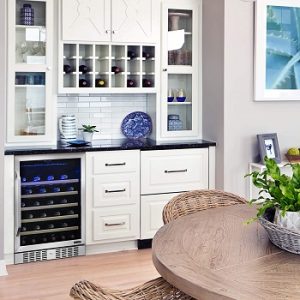
- Interface. Like many appliances these days, wine coolers may have interfaces that range from a simple dial to rotate to set temperature, to digital touchscreens.
- Some wine coolers place the user controls inside the cooler itself while others have a separate external panel.
- Consider whether you would strongly prefer one style or the other. Again this is mostly a matter of personal taste and the functionality you want to have in your wine cooler.
- Temperature memory function – Do you encounter power outage often in your neighborhood? If so, you want a unit that will restore the set temperature when you have your power back on.
- A lock. Having a lock is important to many wine cooler purchasers. It’s a good feature to prevent unwanted guests or children from accessing your vintage collection.
- Shelving material. Shelving is an important usability consideration. There are metal, wood, and wood trimmed metal shelves available.
- Adjustable shelves. A smooth-sliding shelving is a must in our opinion. Do you need removable shelving? Look for shelves that slide and that are adjustable or removable to accommodate unusual bottle sizes.
- Door handle. This component of a wine cooler is important. Why? It’s both functionality and look. We all have a preference of towel-door-handle or curved-handle. Consider the position of the door-handle. Do you want a side-mount or a top-mount. Or, some do not want any handle – yes, a recessed look.
- Carbon filters. Some wine coolers incorporate changeable carbon filters to control odor. If this is important to you, make sure the filter can be readily changed.
8. Warranty
It’s about added convenience and peace of mind to have at least 1-year warranty by the manufacturers. There are a couple of manufacturers that offer exceptional warranty, for example:
- The NewAir Premier Gold series offers one year in home service and repair warranty.
- The Zephyr Presrv series offers 5-year warranty on compressor, 2-year parts and 1 year labor.
9. Budget – how much does a wine fridge cost?
By and large, most wine refrigerators fall into similar price ranges based on capacity. Just be aware that larger capacity generally implies higher price.
- In general, a small counter-top model is less expensive than an under-counter built-in wine cooler.
- Typically a 100-bottle capacity wine cooler costs more than a 36-bottle wine cooler.
- Budget for $200-$400 for a counter-top thermoelectric small wine cooler.
- Budget for $500-$1000+ for an under-counter compressor-base wine cooler.
- Budget for $800-$1000 for a 56-bottle capacity wine cooler.
- Budget for $1000-$1500 for a 100-bottle capacity wine cooler.
- Budget for $1200-$1600 for a 150-bottle capacity wine cooler.
- Budget for $2000-$2300 for a 200-bottle capacity wine cooler.
- Budget for $2500-$3000 for a 300-bottle capacity wine cooler.
Closing thoughts
The best wine fridge is the one that meets your requirements. Take your time to consider the size of your wine collection, and where you would like to install your wine refrigerator.
Use our selection factors above as your check list – yes, you will find the best one for your home bar or your kitchen. Cheers!